8 Window Box and Flower Ideas for the Coop — That Hens Won’t Eat
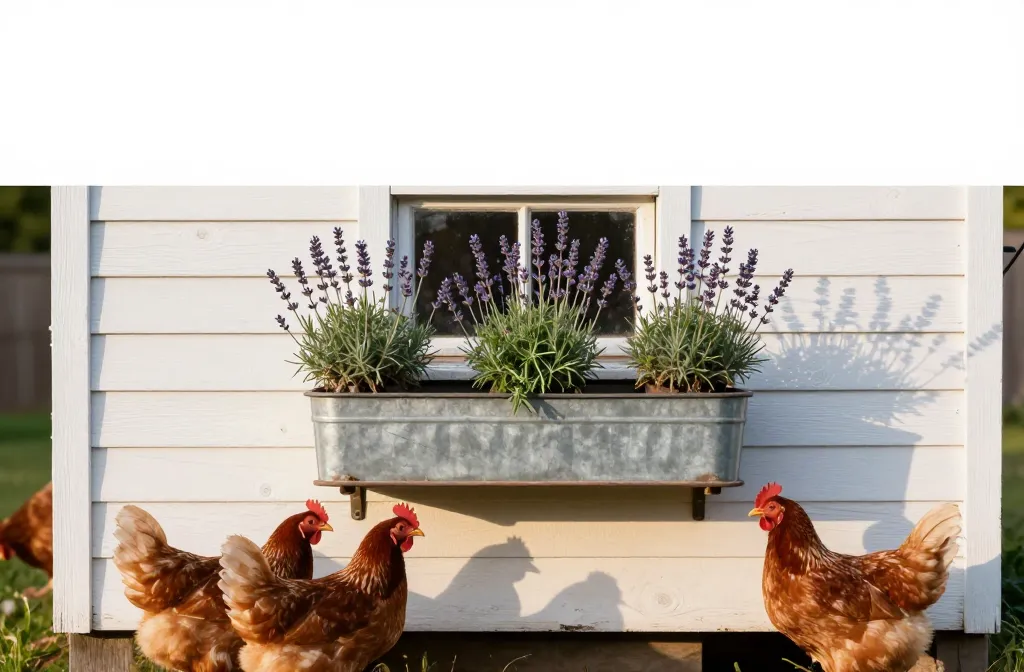
Window box and flower ideas for the coop sounded simple until I watched my pullets hop up and mow down a full planter of pansies in under 20 minutes. I’d screwed the first window box onto the coop while the paint was still tacky because I wanted “cute” fast, and I bought the wrong plants. Here’s what finally survived on my actual coop: 8 plant-and-placement combos my flock ignored or couldn’t reach, how much I spent, and what I’d skip next time. By the end, you’ll have a short list you can buy in one errand and install in an afternoon.
1. Galvanized Planter + Lavender: Smell They Hate, Color You’ll Love
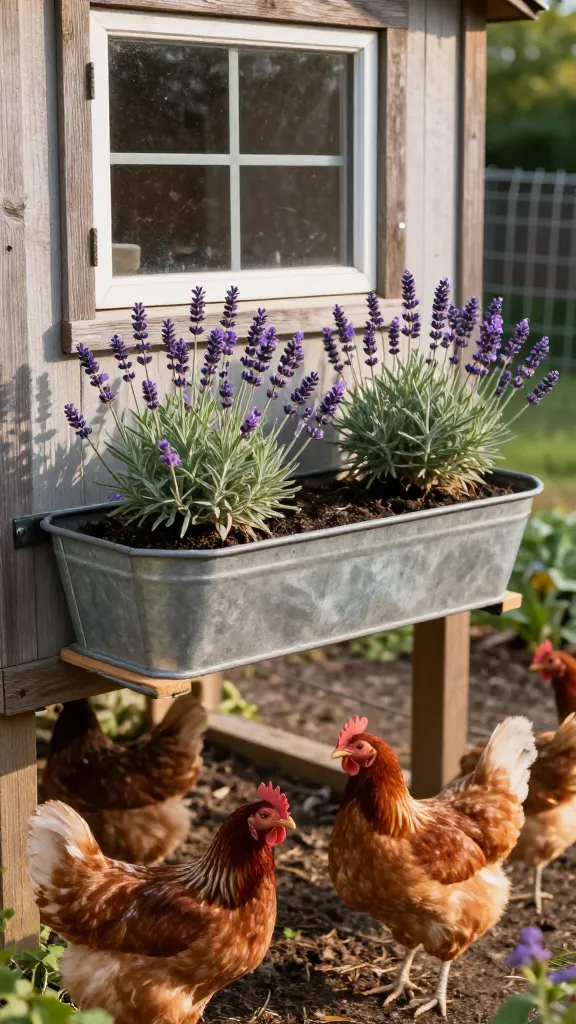
I tried lavender because it was on sale at the garden center end cap and my yard already smelled like wet shavings. I mounted a 24-inch galvanized trough under the south coop window with 2 deck screws per bracket and a shim to cant it 5 degrees outward. The trough was $22, potting mix another $7, and 2 one-gallon lavender plants rang up $18 total. The hens jumped up once, then left it alone; it’s been 2 summers and the plants are woody and happy. The only downside: it dries fast in July heat, so I water every 2 days or the top inch goes bone-dry. Going into the third summer I cut both plants back by half in early spring, and they came back fuller than the original nursery pots ever were, so I haven’t bought replacement lavender since that first $18.
Make it yours: if your climate bakes past 95°, mulch with 1 inch of pine bark; I added a $4 bag and cut watering to every 3 days.
2. High-Mount Window Box + Rosemary: Above the Launch Line

The first time I hung a standard window box at sill height, my Australorp used the hardware as a ladder and stripped the plants in a week. I reinstalled a second box 9 inches higher, level with the top trim, so there’s no perch point. A basic plastic 30-inch box was $12, heavy-duty brackets $10, and I filled it with 3 rosemary starts for $9. At that height, even my best jumper can’t get beak-to-stem without a running start, and rosemary’s resinous taste keeps curiosity low. The catch: high mounting means a steadier hand on the drill and you really do need wall anchors in thin siding. I stripped my first anchor hole trying to eyeball it and had to move the box over 2 inches to hit solid wood, so now I tap the siding first and mark studs before I ever pick up the drill.
Make it yours: on thin plywood coops, back the brackets with a $3 strip of 1×3 inside the wall to spread the load.
3. Metal Rain Gutter Planter + Nasturtiums Outside the Run: Pretty, Not a Buffet

I wanted flowers trailing like a catalog photo, so I repurposed an 8-foot section of metal rain gutter along the shed wall outside the run. The first time I tried this inside the run, the vines lasted 4 days. Outside the wire, it’s safe: gutter offcut $0 (neighbor’s scrap), end caps and hangers $11, potting mix $8, and a seed packet of nasturtiums $2. The hens admire from behind the mesh while the blooms spill. Watch for splash-back: gutter planters need a few 1/8-inch drain holes or your seedlings damp off in week 2. I under-drilled mine the first round, lost half a flat of seedlings to standing water, and went back with a power drill and six more holes; the second planting has never sat wet since.
Make it yours: swap nasturtiums for trailing lobelia if summer runs cool; mine sulked below 65° nights, so I replanted once at $6 for a 6-pack.
4. Herb Ladder Mounted Outside: Hinged and Safe from Beaks
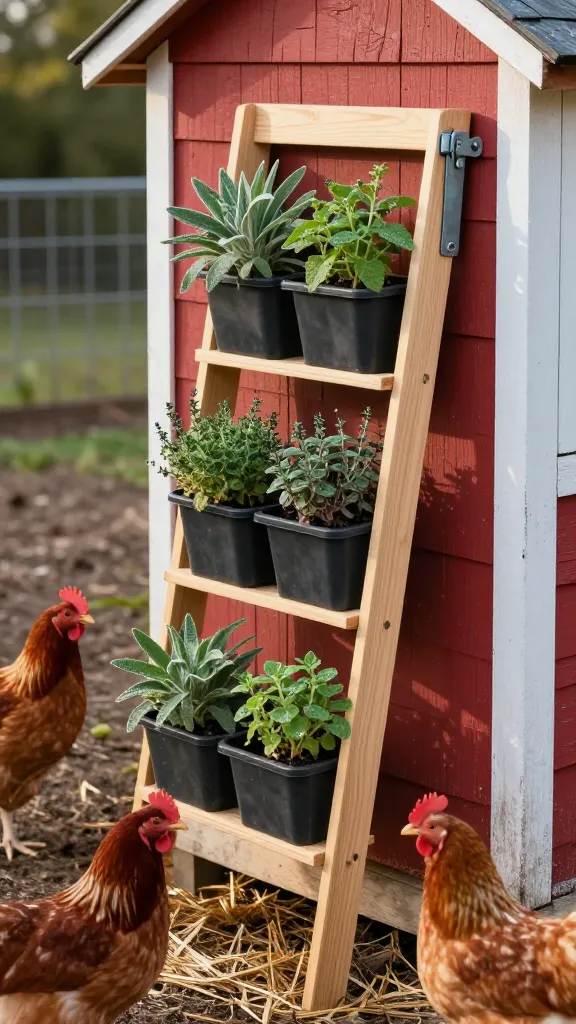
I built a 3-tier herb ladder after pricing pre-made vertical planters twice because I didn’t believe my own math. Mine cost $28 in pine furring strips, $6 in exterior screws, and three 12-inch plastic window boxes at $15 total, hinged to fold up for storms. I planted sage, thyme, and oregano ($10 for 6 small starts). The flock pecked once, decided the leaves were too pungent, and moved on. Eighteen months in, the sage has nearly tripled in size and I split it once already; the thyme stayed compact and is the one I’d plant twice as much of if I rebuilt this today. The hinge is worth it: I fold the whole thing flat when winds hit 30 mph so it doesn’t become a sail.
Make it yours: if you rent, hang the ladder on two screw-in cup hooks so it lifts off without drilling new holes at move-out.
5. Coop Window Box with Marigolds + Wire Guard: Cute Meets Practical
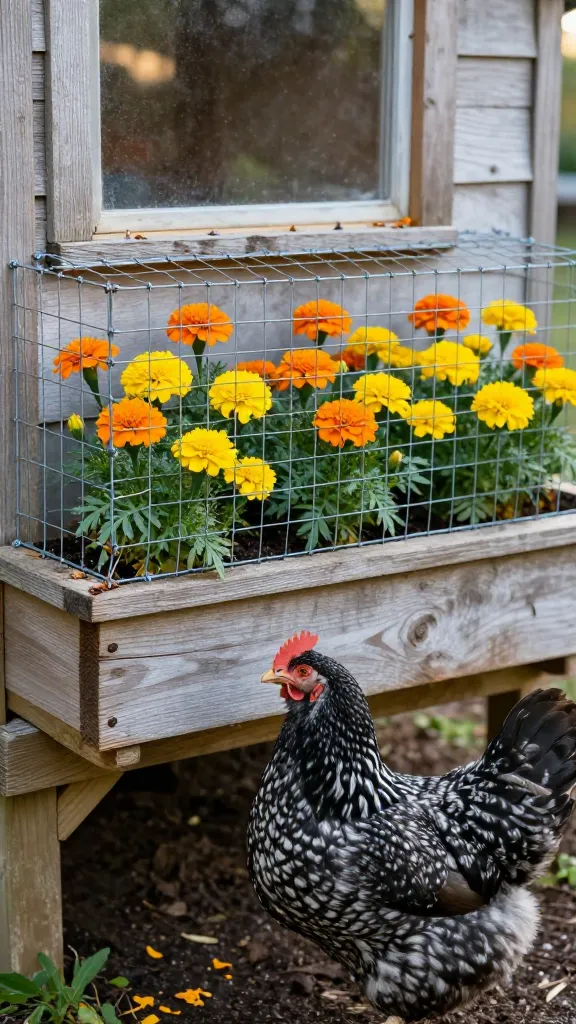
I wanted flowers right under the coop window, but my Barred Rock thinks petals are salad. I added a low-profile 2×2 wire guard around the rim with half-inch hardware cloth so beaks can’t reach the crowns. Box and soil ran $18, marigold 6-packs were $5, and the guard used about 3 feet of hardware cloth ($7 worth from a larger roll). It’s held through 11 months, including one ice storm. The compromise: you see the wire. I’d rather look at a tidy grid than replant chewed stubs every weekend. The guard has held its paint through one ice storm and one hailstorm so far; the only upkeep has been a $6 touch-up coat where the ice chipped a corner.
Make it yours: paint the guard to match your trim; a rattle can of exterior paint was $6 and the wire visually disappears.
6. Raised Whiskey-Barrel Planter at the Corner: Height is Everything
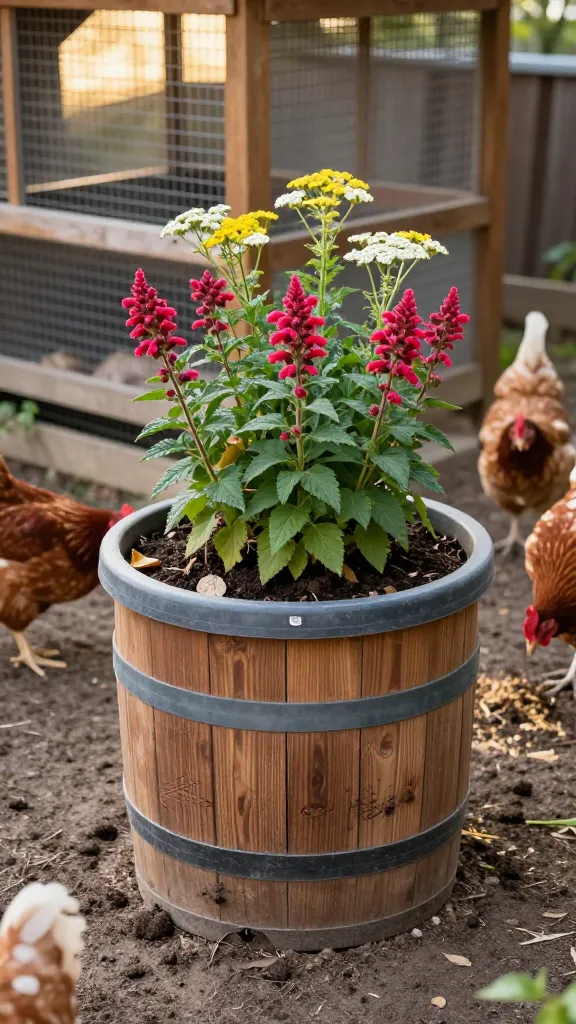
I stuck a half barrel at the coop corner because I had exactly that much level ground left. My first attempt with a ground planter turned into dust-bath central in 48 hours. The barrel (plastic “wood” look) was $35, I filled it with leftover compost and soil ($0), and planted bee balm and yarrow for $14. At 24 inches high, it’s above scratch zone; the hens cruise by and ignore it. The only maintenance is topping up soil once a year because it settles 1-2 inches. By year two the bee balm had outgrown its third of the barrel, so I split the clump with a garden fork, moved half to a second pot for free, and both are blooming again this season.
Make it yours: if you get winter freezes, drill the bottom with 4 quarter-inch holes so water doesn’t freeze and crack the sides.
7. Shade-Tolerant Hostas Beyond the Fence: Green Without the Guilt

Our run gets afternoon shade, so I tried hostas inside for green. Mistake. The leaves lasted a week, then looked like lace. I shifted them 18 inches outside the fence line along the coop, spaced 16 inches apart. The 1-gallon plants were $7 each and I bought 4. Now I get big, lush leaves and the girls can only admire through the mesh. The trick is a narrow trench of gravel between fence and plants ($9 a bag) to keep damp soil from wicking under the run. I also learned to water in the morning instead of evening after one week of slug damage on the new leaves; morning watering dries the soil surface by dusk and the slugs mostly leave them alone now.
Make it yours: on rental soil beds, set hostas in 10-inch nursery pots buried to the rim; they lift clean at move-out.
8. Edible-for-You, Boring-for-Them: Chives and Mint in Tall Pots by the Coop Door

I planted chives and mint in 14-inch pots by the coop door because I grab herbs when I’m out there anyway. The mint in the ground would’ve been a takeover, so pots were a boundary. Two pots were $24, soil $7, and 4 herb starts $12. The birds sniff, maybe taste once, and then remember mint is not a treat. Pots dry faster against sunlit walls; I sunk cheap clay saucers ($6 for two) to catch runoff and cut watering trips in half. I snip the chives back hard every three weeks through summer instead of letting them flower, and they keep pushing new growth instead of going woody the way my first, unpruned pot did.
Make it yours: if summer hits triple digits, slide the pots 12 inches off the wall to stop heat-baking the roots; I scorched a chive clump learning that.
Frequently Asked Questions
What flowers can I put on the coop that chickens won’t eat?
In my yard, lavender, rosemary, sage, thyme, oregano, bee balm, and marigolds survived untouched. I buy 1-gallon herbs at $7–$10 each and tuck in a few $5 six-packs of marigolds for color. Height and access matter as much as plant choice: if they can reach it, they’ll test it.
How do I keep chickens from eating window box flowers?
Mount the box 6–10 inches above the sill so there’s no perch, or add a half-inch hardware cloth rim guard. My guard used about 3 feet of mesh (roughly $7) and stopped all nibbling overnight. Avoid using flimsy screen; they’ll bend it in a week.
Are marigolds safe for the coop window box and will hens eat them?
Marigolds are safe around poultry; mine mostly ignore them, especially when the blooms are above beak height. A single 30-inch box takes one $5 six-pack to fill. If your flock fixates, add a wire rim or swap to rosemary and lavender.
Can I use a rain gutter as a window box on the coop?
Yes, metal gutter sections make sturdy planters if you add end caps and drill 1/8-inch drain holes every 8–10 inches. My 8-foot run cost $19 including hardware and has held up through one freeze-thaw season. Keep them outside the run or high enough that beaks can’t reach.
What herbs look good in a window box and won’t get devoured?
Lavender, rosemary, sage, thyme, and oregano have strong scents and flavors that most flocks ignore. I plant 3–4 starts per 24–30-inch box, about $12–$20 in plants. They’re drought-tolerant once established, but in July I still water every 2–3 days.
Plant it where they can’t launch, and you’ll keep your petals
If you buy one thing first, make it the brackets and a small roll of hardware cloth; then you can pick any plant you like from the “pungent” list without feeding your birds a salad bar. Start with a single 24–30-inch box and two herb starts this weekend — hang it a hand’s length higher than your first instinct, and you’ll see the difference by Monday.
— ask me how I know.