Snake-Proofing the Coop & Eggs
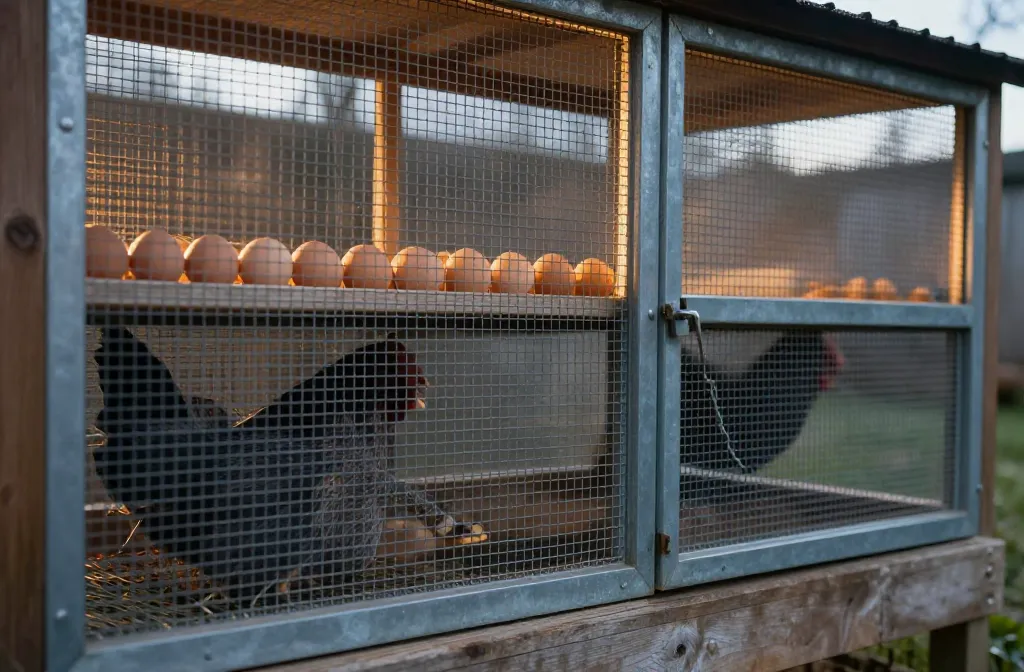
How Snakes Actually Get Your Eggs
Snakes enter through gaps wider than 1/2 inch, climb with leverage from framing and wire, and follow scent straight to nest boxes with eggs left overnight. A rat snake can compress and slip through a space the width of your little finger; the fix is tightening the envelope to 1/4–1/2 inch hardware cloth everywhere and collecting eggs twice daily in warm months.
Snake-proofing the coop & eggs starts at ground level, where most snakes slip in: through a thumb-width gap, under a loose skirt, or right up to an unprotected nest. If your eggs are going missing at dawn and you find yolk smears but no shells, a snake has had breakfast. I have pulled a five-foot rat snake from beneath a nest shelf and once rebuilt a pop-door frame after losing two clutches in one week. By the end of this guide you’ll know every weak point a snake uses, the exact mesh, gap, and latch standards to close them, and how to collect and store eggs so you don’t bait a problem you then have to evict.
The standard: snakes enter through gaps wider than 1/2 inch, climb with leverage from framing and wire, and follow scent straight to nest boxes with eggs left overnight. A rat snake can compress and slip through a space the width of your little finger; a juvenile can pass through holes smaller than that. They scale wire like a ladder, wedge upward along corner studs, and push through loose door bottoms and warped frames. The fix is simple and thorough: tighten the envelope to 1/4–1/2 inch hardware cloth everywhere, block climb routes, seal the floor line, and remove the incentive by collecting eggs twice daily in warm months.
Hardware Cloth: Your Non-Negotiable Barrier
Skin the coop and any run with 19-gauge, 1/2-inch galvanized hardware cloth on every opening larger than a pencil. For extra insurance against juveniles, line nest and broody areas with 1/4-inch cloth; attach with exterior-rated screws and fender washers every 4 inches on center, not staples alone.
The standard: skin the coop and any run with 19-gauge, 1/2-inch galvanized hardware cloth on every opening larger than a pencil. For extra insurance against juveniles, line nest and broody areas with 1/4-inch cloth. Attach hardware cloth with exterior-rated screws and fender washers every 4 inches on center, not staples alone, and overlap seams by at least 2 inches with a second row of fasteners through both layers.
Snake-Proofing the Coop Envelope
No opening larger than 1/2 inch anywhere a snake can reach, including the roofline. Frame vent openings with 1x2s and sandwich the mesh between boards for a rigid seal; replace warped door stops and add a 3/4-inch exterior door sweep to the pop door so it closes flush with less than a 1/8-inch light gap.
The standard: no opening larger than 1/2 inch anywhere a snake can reach, including the roofline. Inspect every edge: under the sill plate, around the pop door, at vents, eaves, and where wire meets wood. Frame vent openings with 1x2s and sandwich the mesh between boards for a rigid seal; caulk is not a fix for a structural gap. Replace warped door stops and add a 3/4-inch exterior door sweep to the pop door so it closes flush against the threshold with less than a 1/8-inch light gap.
Dig Line, Skirt, and Floor Seals
Create a ground barrier a snake cannot slip under or through: a hardware cloth apron 24 inches wide around the perimeter, buried or laid flat and pinned with landscape staples every 12 inches. Where a solid floor meets walls, seal the seam with a pressure-treated 2x base and exterior screws; any run-to-coop transition must be overlapped and screwed—no zip ties at ground level.
The standard: create a ground barrier a snake cannot slip under or through. If your coop sits on soil, add a hardware cloth apron 24 inches wide around the perimeter, buried or laid flat and pinned with landscape staples every 12 inches, extending outward, then covered with 2–3 inches of soil or gravel. Where a solid floor meets walls, seal the seam with a pressure-treated 2x base and exterior screws; if you use deep litter, keep litter pulled back 2 inches from doorways so it doesn’t hold doors ajar. Any run-to-coop transition must be overlapped and screwed—no zip ties at ground level. According to Garden Betty and Kalmbach Feeds, reinforcing the bottom three feet with hardware mesh and sinking it an additional six inches to a foot underground stops snakes and other potential egg thieves who can be accomplished burrowers — and hardware mesh or hardware cloth is essential, not chicken wire, which has holes too large to keep out skunks, weasels, and snakes.
Roofs, Eaves, and Climb Routes
Close the top as tightly as the bottom and remove ladders: cover eave vents with 1/4–1/2 inch hardware cloth framed and screwed into studs, cap fence posts and run uprights, and trim back vegetation within 18 inches of the coop walls. Where wire meets rafters, run a continuous batten strip to force a hard corner the mesh can bite into, not a soft bend a snake can nose past.
The standard: close the top as tightly as the bottom and remove ladders. Cover eave vents on the inside with 1/4–1/2 inch hardware cloth framed and screwed into studs. Cap fence posts and run uprights; snakes use open tops as perches to launch into the roof. Trim back vegetation within 18 inches of the coop walls and run—ivy, stacked boards, and leaning tools are all rungs on a ladder. Where wire meets rafters, run a continuous batten strip to force a hard corner the mesh can bite into, not a soft bend a snake can nose past.
Nesting Boxes: Remove the Bait, Protect the Doorway
Eggs do not sit overnight: collect morning and late afternoon in warm weather and at lockup if you’ve had losses. Install nest curtains of tightly woven fabric cut into 2-inch strips to reduce line-of-sight and scent plume; seal the backside and undersides of external boxes with 1/4-inch hardware cloth and backer board so there’s no hollow where a snake can coil.
The standard: eggs do not sit overnight. Collect morning and late afternoon in warm weather and at lockup if you’ve had losses. Install nest curtains of tightly woven fabric cut into 2-inch strips to reduce line-of-sight and scent plume; mount them to hang within 1 inch of the floor of the box. Seal the backside and undersides of external boxes with 1/4-inch hardware cloth and backer board so there’s no hollow where a snake can coil. Close and latch external nest lids with a positive latch; a lid that overhangs with a 1/8-inch gap is an open invitation.
Doors, Latches, and Automatic Openers
A door that truly shuts, and a latch that cannot be pried into a gap: use a pop door that closes into a 3/4-inch U-channel on both sides with less than 1/8-inch clearance. For people doors and external nest lids, install a two-step latch plus a carabiner through the hasp; while snakes don’t pick latches, loose ones leave gaps at corners where they enter.
The standard: a door that truly shuts, and a latch that cannot be pried into a gap. Use a pop door that closes into a 3/4-inch U-channel on both sides with less than 1/8-inch clearance; guillotine-style tracks with wide play leave channels along the edges. Add an interior stop so the door seats tight across the bottom. For people doors and external nest lids, install a two-step latch plus a carabiner through the hasp; while snakes don’t pick latches, loose ones leave gaps at corners where they enter.
Feed, Rodents, and What Attracts Snakes
Control rodents to remove the reason snakes patrol your coop: store feed in a metal can with tight lid, remove any feeder from the run overnight, and set snap traps in covered, chicken-safe boxes outside the run perimeter. Do not use poison where chickens or pets live, and do not bait with eggs unless you want to teach the wrong lesson.
The standard: control rodents to remove the reason snakes patrol your coop. Store feed in a metal can with tight lid, and remove any feeder from the run overnight. Switch to a feeder that minimizes spillage; sweep or rake under it every 48 hours. Set snap traps in covered, chicken-safe boxes outside the run perimeter and along building edges, checking them daily; do not use poison where chickens or pets live, and do not bait with eggs unless you want to teach the wrong lesson.
Lighting, Timing, and Habits That Help
Lock the coop at dusk, not “later”: snakes move most at dusk and early night in warm months, so a pop door left open until your 10 p.m. round is a window. Add a small solar motion light outside the coop door to disrupt approach and help your own checks; keep a lightweight snake hook or long-handled garden hoe hung outside the coop for calm removal.
The standard: lock the coop at dusk, not “later.” Snakes move most at dusk and early night in warm months; a pop door left open until your 10 p.m. round is a window. Add a small solar motion light outside the coop door to disrupt approach and help your own checks. Keep a lightweight snake hook or long-handled garden hoe hung outside the coop; if you must remove a nonvenomous snake, do it calmly, into a tall rubber bin with a latching lid, and relocate per your local wildlife rules.
What to Do If You Find a Snake in the Coop
Secure the flock first, identify, then remove safely or call for help: move hens to a closed section of the run or a dog crate, then close the coop. From a safe distance, note head shape, pupil type, and pattern; use a hook to lift and guide it into a tall bin, and release at least 1/4 mile away where legal — if you suspect a venomous species, contact animal control.
The standard: secure the flock first, identify, then remove safely or call for help. Move hens to a closed section of the run or a dog crate, then close the coop. From a safe distance, note head shape, pupil type, and pattern; in many regions, most egg raiders are nonvenomous rat snakes or gopher snakes. Use a hook to lift and guide it into a tall bin; release at least 1/4 mile away where legal. If you suspect a venomous species or you’re unsure, contact local animal control or a licensed wildlife removal service; do not risk a bite.
Seasonal Tactics: Heat, Hatchlings, and Timing
Expect more snake activity from late spring through early fall, especially after warm rains: tighten egg collection to twice daily, check door sweeps weekly, and walk the perimeter with a flashlight at lockup looking for gaps. In cold months, snakes seek warm voids—insulate external nest box lids and fill any hollow cavities with foam to remove winter dens.
The standard: expect more snake activity from late spring through early fall, especially after warm rains. In this window, tighten egg collection to twice daily, check door sweeps weekly, and walk the perimeter with a flashlight at lockup looking for gaps that show light. After heavy mowing or nearby construction, revisit your seals; displaced snakes explore. In cold months, they’ll seek warm voids—insulate external nest box lids and fill any hollow cavities with foam to remove winter dens.
Repellents, Decoys, and What Not to Waste Money On
Physical exclusion beats scent gimmicks every time: mothballs, sulfur powders, predator urine, and rubber “snake decoys” don’t hold up to rain or habit. If you want an assist, a fine gravel band 12 inches wide around the coop makes slithering noisy and exposed, but it is only a supplement to hardware cloth.
The standard: physical exclusion beats scent gimmicks every time. Mothballs, sulfur powders, predator urine, and rubber “snake decoys” don’t hold up to rain or habit; a hungry snake ignores them. If you want an assist, a fine gravel band 12 inches wide around the coop makes slithering noisy and exposed, but it is only a supplement to hardware cloth. My firm opinion, stated once: Spend every dollar on hardware cloth and fasteners before you buy a single “repellent.”
Audit Your Coop for Snake Entry
Measure and verify—don’t guess: at dusk, stand inside the closed coop and look for light; any beam wider than 1/8 inch at doors or corners gets fixed this week. Push a 1/2-inch dowel against vents, eaves, and wire seams; if it passes, so will a snake. Confirm all wire panels are screwed every 4 inches with washers and skirting is intact for a full 24-inch perimeter.
The standard: measure and verify—don’t guess. At dusk, stand inside the closed coop and look for light; any beam wider than 1/8 inch at doors or corners gets fixed this week. Push a 1/2-inch dowel against vents, eaves, and wire seams; if it passes, so will a snake. Confirm all wire panels are screwed every 4 inches with washers, skirting is intact for a full 24-inch perimeter, and nesting areas are closed on all sides—no hollow shelves, no open undersides.
Frequently Asked Questions
What size hardware cloth keeps snakes out of a chicken coop?
Use 1/2-inch, 19-gauge galvanized hardware cloth for all general openings. In nest areas or where you’ve seen juveniles, add an inner layer of 1/4-inch cloth. Fasten with screws and washers every 4 inches, overlapping seams by 2 inches.
How do I snake-proof nesting boxes without rebuilding everything?
Line the backside and underside of each box with 1/4-inch hardware cloth screwed to framing, add tight curtains that hang within 1 inch of the floor, and latch the lid with a two-step latch. Then collect eggs twice daily in warm months so you’re not advertising.
Do motion lights help with snake-proofing the coop & eggs?
Yes, as a supplement. A small solar motion light at the pop door makes approach riskier and helps you spot movement at lockup, but it does not replace hardware cloth, door sweeps, and 1/2-inch gaps or less. Think of light as your helper, not your fence.
Can snakes get through chicken wire around the run?
Yes. Chicken wire openings are typically about 1 inch, which admits snakes and rodents. Skin over it with 1/2-inch hardware cloth to the full height, and add a 24-inch ground apron.
How far should I relocate a nonvenomous snake I find in the coop?
At least 1/4 mile, and follow local wildlife regulations. Use a long-handled hook to place it in a tall, lidded bin for transport. If identification is uncertain or venom is possible, call animal control or a licensed remover.
Why are my eggs disappearing but I never see a snake?
Snakes often raid at dusk and pre-dawn and leave little trace beyond a smear of yolk. Confirm by collecting eggs twice daily for a week, dusting nest rims with fine flour to capture scale tracks, and sealing any gap wider than 1/2 inch you find during a light test.
Quick Comparison: Snake-Proofing Standards
| Component | Standard | Common Mistake |
| Hardware cloth mesh size | 1/2-inch, 19-gauge galvanized | Chicken wire (1-inch openings) |
| Nest area reinforcement | 1/4-inch cloth inner layer | Standard 1/2-inch only |
| Fastening method | Screws + washers every 4 inches | Staples alone |
| Seam overlap | 2 inches minimum, double-fastened | Butt joints or single row |
| Ground apron | 24 inches wide, pinned every 12 inches | No apron or buried only |
| Door gaps | Less than 1/8 inch light gap | Warped stops or no sweep |
| Vent framing | Sandwiched between 1×2 boards | Caulk over structural gaps |
| Egg collection | Twice daily in warm months | Once daily or overnight leave |
| Vegetation clearance | 18 inches from coop walls | Ivy and stacked boards as ladders |
| Rodent control | Metal feed cans, snap traps in covered boxes | Poison where chickens live |
Do It Right Once
The standard is a tight envelope—1/2-inch hardware cloth, sealed doors with less than 1/8-inch gaps, a 24-inch ground apron, and eggs never left overnight. Start tonight with a light test inside the coop and a second egg collection; this weekend, skin every opening with hardware cloth and add the apron. For a comprehensive approach to predator pressure, the predator-proofing checklist covers diggers, climbers, and flyers beyond just snakes. If you’re dealing with specific raccoon pressure, the raccoon-proofing guide explains locks and latches in detail. And when you’re ready to think about every weak point in your coop’s security, the hardware cloth vs. chicken wire guide breaks down the critical differences.