Hawk Deterrent Ideas for Backyard Chickens
How Hawks Take Birds — And the Window You Can Close
The standard hawk kill is a daytime strike from above, on open ground within 20–30 feet of a perch or glide path, in the first 2 hours after sunrise or the hour before dusk. They watch from a tree, pole, or roof edge, then drop low and drive a panic. Your job is to remove overhead access, shrink long sightlines, and force a hawk to thread obstacles it will not risk. If your hens range, you must give solid overhead cover within 10 feet anywhere they feed or dust bathe.
A hawk hits fast and quiet — you hear the flock blow up, then the sudden empty. This guide lays out practical hawk deterrent ideas for backyard chickens that work in daylight, in winter, and when you’re not watching. I have lost two birds to hawks and changed my setup the same week; I have not lost one since. By the end, you’ll know exactly how to harden your run roof, break a hawk’s attack line-of-sight, and train your flock to use cover without turning your yard into a junkyard.
Non-Negotiable: Roof the Run or Net It Tight
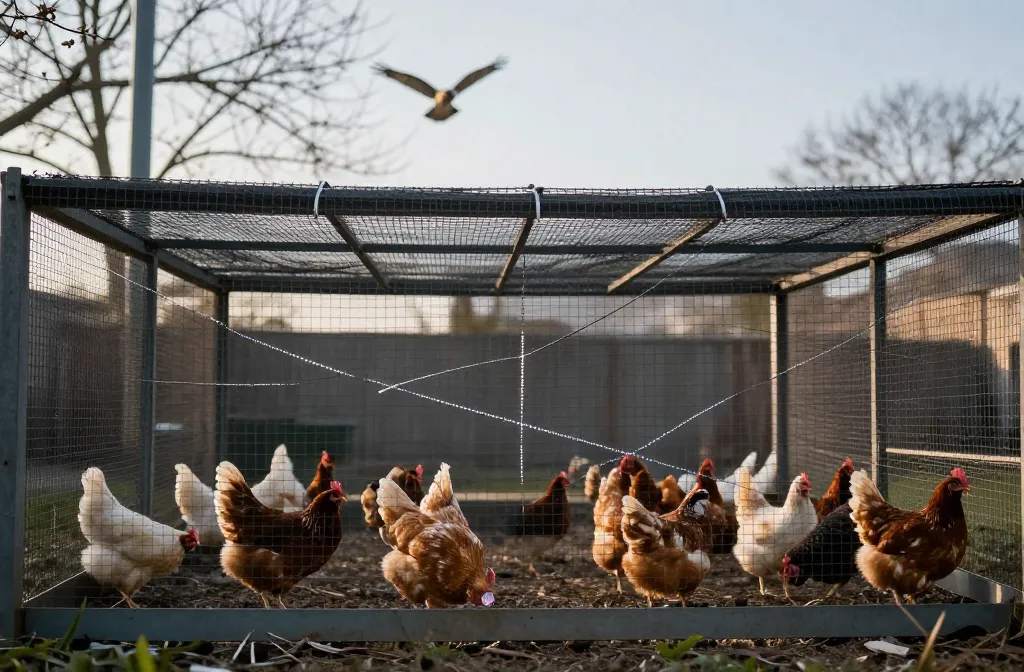
The standard for a secure day run is a solid or wire roof on every square foot. For permanent runs, install 19-gauge 1/2-inch hardware cloth over the entire top, tensioned and attached every 6 inches with poultry staples or self-tapping screws and fender washers. For large or irregular areas, use UV-stable 2-inch overhead bird netting stretched tight with paracord or cable, anchored to posts at 8–10 feet spacing; overlap seams by 12 inches and zip-tie every 6 inches.
The standard for a secure day run is a solid or wire roof on every square foot. For permanent runs, install 19-gauge 1/2-inch hardware cloth over the entire top, tensioned and attached every 6 inches with poultry staples or self-tapping screws and fender washers. For large or irregular areas, use UV-stable 2-inch overhead bird netting stretched tight with paracord or cable, anchored to posts at 8–10 feet spacing; overlap seams by 12 inches and zip-tie every 6 inches.
According to Kummer Homestead, overhead netting that prevents predators like hawks from swooping in can be incredibly effective — they successfully used a combination of regular bird netting and a special Hawk Stopper net to prevent attacks. The Wild Hearth Life predator-proof run guide confirms that hardware cloth is the backbone of any predator-proof run, and for overhead protection, it must be supported at least every 12–16 inches to prevent sagging.
Hawk Deterrent Cover in Open Yards
If you free-range, the standard is one solid refuge every 20–25 feet of open ground, big enough for your largest hen to sprint to in 3–4 seconds. Use low, rigid structures: a 2×4-foot plywood shelter on 18-inch legs, cattle panels bent into a 6-foot-long hoop with tarps covering the top third, or evergreen shrubs with branches to the ground. Space them so no hen is ever more than 10 feet from shade or an exit route; hawks prefer a long clear run-in and an open exit, so break both.
If you free-range, the standard is one solid refuge every 20–25 feet of open ground, big enough for your largest hen to sprint to in 3–4 seconds. Use low, rigid structures: a 2×4-foot plywood shelter on 18-inch legs, cattle panels bent into a 6-foot-long hoop with tarps covering the top third, or evergreen shrubs with branches to the ground. Space them so no hen is ever more than 10 feet from shade or an exit route; hawks prefer a long clear run-in and an open exit, so break both.
Hawk Deterrent Visuals: Lines, Flash, and Confusion
Hawks key on straight paths and consistent silhouettes — break that with crisscrossed line and a few moving flashes. Run fishing line or paracord in a grid over free-range zones with 24–36 inch spacing between lines, anchored at 7–9 feet high so you can walk under it. Add 3–5 reflective streamers or old CDs per 100 square feet, hanging down 18–24 inches, to toss light and movement. These are supplements, not substitutes for a roofed run; line grids reduce strike frequency but won’t stop a determined bird that’s already stooping.
Hawks key on straight paths and consistent silhouettes. Break that with crisscrossed line and a few moving flashes. Run fishing line or paracord in a grid over free-range zones with 24–36 inch spacing between lines, anchored at 7–9 feet high so you can walk under it. Add 3–5 reflective streamers or old CDs per 100 square feet, hanging down 18–24 inches, to toss light and movement. These are supplements, not substitutes for a roofed run; line grids reduce strike frequency but won’t stop a determined bird that’s already stooping.
Guardian Presence and Flock Habits
A consistent large presence during peak hunting hours helps; scatter feed under cover at sunrise and again near late afternoon, and confine birds to the run during known hawk seasons — usually late fall through early spring when leaves are down and wild prey is scarce. I trained my flock on a three-second “call-in” with a metal scoop and scratch tossed inside the run; it took two weeks to become automatic, and it has beaten more than one shadow overhead.
A consistent large presence during peak hunting hours helps. If you don’t keep a dog trained to ignore chickens, your own routine matters: scatter feed under cover at sunrise and again near late afternoon, and confine birds to the run during known hawk seasons — usually late fall through early spring when leaves are down and wild prey is scarce. I trained my flock on a three-second “call-in” with a metal scoop and scratch tossed inside the run; it took two weeks to become automatic, and it has beaten more than one shadow overhead.
Decoys, Owls, and Other Gimmicks — What Actually Helps
Stationary plastic owls and balloons work for about 48–72 hours before habituation; if you use them, move them daily and combine with line grids and cover. A rooster with good sense can reduce surprise and buy 3–5 seconds of warning; a reckless one dies first. Whistles and air horns interrupt an active attack but don’t prevent the next one; use them as part of your call-in drill, not as a plan.
Stationary plastic owls and balloons work for about 48–72 hours before habituation. If you use them, move them daily and combine with line grids and cover. A rooster with good sense can reduce surprise and buy 3–5 seconds of warning; a reckless one dies first. Whistles and air horns interrupt an active attack but don’t prevent the next one; use them as part of your call-in drill, not as a plan.
Seasonal Adjustments That Make a Difference
Winter needs more structure and less range time — with leaves off, extend your netting or line grid out another 8–10 feet, and increase refuges so spacing is closer to 15–20 feet. In summer, dense shrubs can be enough if you keep waterers and feed under solid roofs, not in the open. During migration spikes, lock birds into the roofed run for 7–10 days rather than “hoping it passes.”
Winter needs more structure and less range time. With leaves off, extend your netting or line grid out another 8–10 feet, and increase refuges so spacing is closer to 15–20 feet. In summer, dense shrubs can be enough if you keep waterers and feed under solid roofs, not in the open. During migration spikes, lock birds into the roofed run for 7–10 days rather than “hoping it passes.”
Building a Hawk-Safe Day Run (Materials and Steps)
The standard build for a predator-resilient day run handles hawks first, then everything else — set corner and mid-span posts at 10-foot spacing 24–30 inches deep, frame the top and bottom rails, skin walls with hardware cloth, install a 36-inch apron, roof the front two-thirds with hardware cloth and back one-third with solid panels, and add at least two covered refuges inside.
The standard build for a predator-resilient day run handles hawks first, then everything else. Here is the clean, weekend approach for a 10×20-foot run you can scale up.
Materials (for a 10×20 run)
- Eight pressure-treated 4×4 posts, 10 feet long
- Framing lumber: twelve 2x4s, 10 feet; twelve 2x4s, 8 feet
- 19-gauge 1/2-inch hardware cloth: at least 500 square feet (walls + roof)
- Self-tapping screws and 1-inch fender washers: 400+
- Heavy-duty poultry staples: 1 lb
- Exterior-grade hinges and a lockable hasp for the door
- Gravel for post holes: 8 bags
- Roofing option: corrugated metal or polycarbonate panels for at least 120 square feet of solid shade
- UV-stable zip ties for seams: 200
- Ground apron: additional hardware cloth, 36 inches wide, for perimeter
Steps
- Set corner and mid-span posts at 10-foot spacing, 24–30 inches deep in tamped gravel. Aim for a finished wall height of 7 feet.
- Frame the top and bottom rails with 2x4s, fastening with exterior screws. Add a center ridge 2×4 along the run’s long axis for roof support.
- Skin the walls with hardware cloth from bottom rail to top rail, pulling tight. Attach every 4–6 inches with screws and washers at studs, staples in between.
- Install a 36-inch hardware cloth apron around the run, fastened at the base and laid flat outward. Pin with landscape staples and cover with 2–3 inches of soil or gravel.
- Roof the front two-thirds with hardware cloth, stretched tight and attached every 6 inches. Roof the back one-third with solid panels for weather and shade.
- Hang the door, skin it with hardware cloth, and add a lockable hasp. Set the threshold less than 1 inch off grade to close gaps.
- Inside, add at least two covered refuges: a 2×4-foot bench with a solid top at 18 inches high and a low shrub or brush pile substitute in one corner.
A tight roofed run is your everyday safety net; free-range can be a bonus window, not the baseline.
What Fails Against Hawks (And Why)
Loose bird netting draped over posts snags, sags with dew, and opens gaps after the first wind; single scare owls parked on a fence become scenery in days; open feeders and waterers out in the yard keep birds exposed on and off all day; and one big shelter 50 feet from where hens actually forage is theater. Move feeders under a roof or a solid shelter with at least a 2×3-foot cover. Set smaller, closer refuges instead.
Loose bird netting draped over posts snags, sags with dew, and opens gaps after the first wind; a hawk hits the droop and is inside. Single scare owls parked on a fence become scenery in days. Open feeders and waterers out in the yard keep birds exposed on and off all day; move them under a roof or a solid shelter with at least a 2×3-foot cover. Finally, one big “shelter” 50 feet from where hens actually forage is theater — set smaller, closer refuges instead.
My One Firm Opinion
Hang whatever you want in the trees, but you cannot call a yard hawk-safe without a tight overhead barrier on the run.
Hang whatever you want in the trees, but you cannot call a yard hawk-safe without a tight overhead barrier on the run.
Hawk Deterrent Ideas You Can Add in an Afternoon
String a 24–36 inch grid of line over your most-used free-range patch; build two plywood “low tables” 24×48 inches on 16–18 inch legs and place them 20 feet apart; relocate feed and water fully under a solid roof; install a 2–3 note call-in routine and reward under cover twice daily for 14 days; move any decoy or reflective streamer daily.
- String a 24–36 inch grid of line over your most-used free-range patch; tension every span; tie off to screw eyes in fence posts.
- Build two plywood “low tables,” 24×48 inches on 16–18 inch legs, and place them 20 feet apart.
- Relocate feed and water fully under a solid roof; the edge should extend at least 12 inches beyond the vessel.
- Install a 2–3 note call-in routine and reward under cover, twice daily for 14 days.
- Move any decoy or reflective streamer daily, and change their height by 12–18 inches each move.
Audit Your Yard for Hawk Risk — Tonight
A systematic audit covers: stand at your fence line and on your deck to identify 30+ feet of open chicken space that needs line or cover; count refuges to confirm solid cover within 10 feet during peak hours; check the run roof for zero gaps larger than 2 inches and seams fixed every 6 inches; trim or deny launch perches within 25 feet of your range zone; stage tools like whistle or horn by the back door.
- From a hawk’s eye: stand at your fence line and on your deck; anywhere you see 30+ feet of open chicken space needs line or cover.
- Count refuges: is there solid cover within 10 feet of where birds spend time from 7–9 a.m. and 4–6 p.m.?
- Check the run roof: zero gaps larger than 2 inches, seams fixed every 6 inches, no sag deeper than 2 inches.
- Look up: trim or deny launch perches within 25 feet of your range zone — low limbs, pergolas, shed peaks.
- Tools staged: whistle or horn by the back door; scoop and scratch at the run gate for immediate call-in.
Frequently Asked Questions
What are the most effective hawk deterrent ideas for backyard chickens?
Roof the run with 1/2-inch hardware cloth or tight bird netting, add solid refuges every 20–25 feet, and string a 24–36 inch grid of line over free-range zones. Pair that with a call-in routine at sunrise and late afternoon. Those four steps cut daytime strikes dramatically.
Will fishing line over my yard stop hawks?
A grid spaced at 24–36 inches and set at 7–9 feet high reduces attack attempts by blocking clean stoops, but it is not a substitute for a roofed run. Use it to protect short, supervised range windows, not as your only defense. Keep lines tight and re-tension after wind.
Do owl decoys keep hawks away from chickens?
Only briefly. If you move them daily and combine with overhead line and cover, they can add hesitation. Left in one spot, hawks ignore them within 2–3 days.
How close should cover be for chickens to escape hawks?
Place solid cover so no bird is more than 10 feet from protection, with refuges every 20–25 feet across open ground. A 2×4-foot shelter on 18-inch legs works well and doesn’t collect mud under it.
Is bird netting safe for a chicken run roof?
Yes if it’s UV-stable, installed tight with 12-inch overlaps, and supported so it doesn’t sag more than 2 inches. In snow country, reinforce with a center ridge and sweep snow before it builds. Hardware cloth is the buy-once upgrade that survives weather and raccoons.
When are hawk attacks most common on backyard chickens?
Expect the most pressure in late fall through early spring, and during the first two hours after sunrise and the hour before dusk. Lock birds in the roofed run during those windows, then range behind line grids and cover at midday when pressure is lower.
Quick Comparison: Hawk Deterrent Methods
| Method | Effectiveness | Installation | Duration |
| Hardware cloth roof | Very high — physical barrier | Attach every 6 inches, supported every 12–16 inches | Permanent, buy-once |
| Bird netting (UV-stable) | High — physical barrier | Overlap seams 12 inches, zip-tie every 6 inches | 2–5 years before replacement |
| Fishing line grid | Moderate — blocks clean stoops | 24–36 inch spacing, 7–9 feet high | Seasonal, re-tension after wind |
| Refuge shelters (every 20–25 feet) | High — escape cover | 2×4-foot plywood on 18-inch legs | Permanent structure |
| Owl decoys | Low — habituates in 48–72 hours | Move daily, combine with other methods | Temporary supplement only |
| Call-in routine | High — behavioral control | Train 14 days with treat reward | Ongoing, automatic after training |
Do It Right Once
Secure birds from above first, then make free-range possible on your terms. If you do just one thing this week, tension a roof over the run — hardware cloth or tight net — and move the feed under it; that’s an hour that buys you years. For the full predator-proofing checklist that covers all threat types, the predator-proof checklist walks through every weak point. For the hardware cloth specs and installation details, the hardware cloth guide explains the differences. And for stopping diggers who bypass the roof entirely, the predator apron guide shows how to install a perimeter defense.